
The third biggest change will be on racing tracks.
Currently it’s the single circuit or city to stipulate deals withe the Formula One management to secure the chance of hosting a grand prix; they’re requested to pay ridiculous fees to do that.
With the new organization, as described in my previous posts, there will be a Formula One circuit database, including all venues that are respecting all safety standards for having a race.
They’ll be devided by country and by regional area; slots in the F1 World Title and in the continental ones are assigned to a country based on how many tracks each has in the database.
Countries will have to rotate compliant circuits every year; by having slots in both the world stage and the continental one, the risk for a track not being used for too long is non existent.
The maximum number of racecourses for each country is 8, except the U.S.A. which are split into three areas, East, Center and West for 24 tracks in total.
Thanks to the elimination of fees and allowing host venues to get a percentage of the income it will be much easier to attract more, new or already existing, circuits.
By doing this, the usual predictability of who is better in a particular circuit year after year is eliminated and the Formula One show is brought to almost every country in the world and in different cities inside each one.
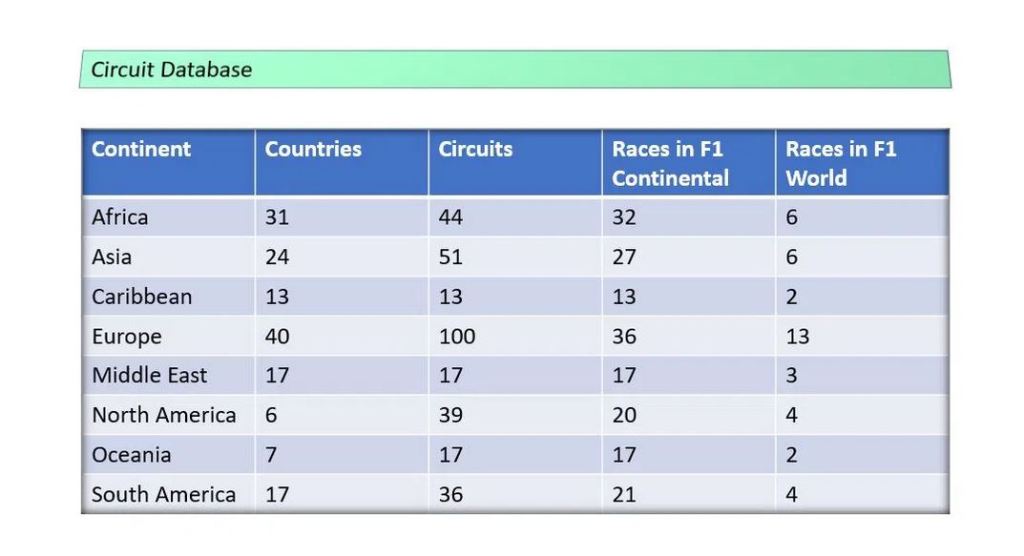
As shown in the picture I’ve created a database of 155 countries and 317 racetracks, some designed by me, that will be part of a 40-race-long World Title season and of the continental Championships.
The split for each continent in the World Formula One is generated by the percentage of circuits available against the total.
Let’s clarify the criteria used for creating the calendars:
– Africa has 31 countries with at least one circuit and only South Africa with more than four.
Therefore there will be 32 races for the continental serie, with one spot for each country and two for South Africa.
Six races of the F1 World Title will be held in African circuits, with only South Africa having a secured slot.
– Asia has 24 countries with 51 circuits.
China, Japan and Russia will have two assigned races, for a 27 GPs in the continental Championship.
Six races also part of the F1 main title and one for each of the three above countries guaranteed.
– The Caribbean has 13 countries with one racetrack each.
Simple thirteen race long continental season and two slots in the World Title.
– Europe has 40 countries and a total of 100 circuits.
For this continent allocation is a bit more complicated: countries with more than five circuits will have the chance to host two races per year, those with 2 to 4 will host one and finally nations with only one circuit will host a race every two year, alternating.
Following this rules the F1 European title will be a 36 GP season.
13 races of the F1 World Title will be done in Europe, as Spain, France, Italy, Germany and England will have a guranteed spot.
– Middle East has 17 countries with one circuit each.
The continental season will include all circuits while 3 will host also a main F1 event.
– North America has 6 geographical areas (including the three of the U.S.A.) and 39 circuits.
A 20 races season will feature 12 GPs in the United States, 4 in Canada and 3 in Mexico.
The allocation of races in the World Title is four, two in the States and one each in Canada and Mexico.
– Oceania has 7 countries and 17 circuits.
Again the continental serie will feature a race in all of them, while only 2 slots will be allocated in the World F1; Australia will have one guaranteed.
– South America has 17 nations and 36 venues.
With 3 races held in Brazil and Argentina the continental season will have 21 total GPs.
The two countries will have also one secured race of the F1 World Championship out of the 4 total given to this continent.
With my next posts I’ll present the detailed calendars of each continental season and of the F1 World Title.
 All Along The Racetrack