

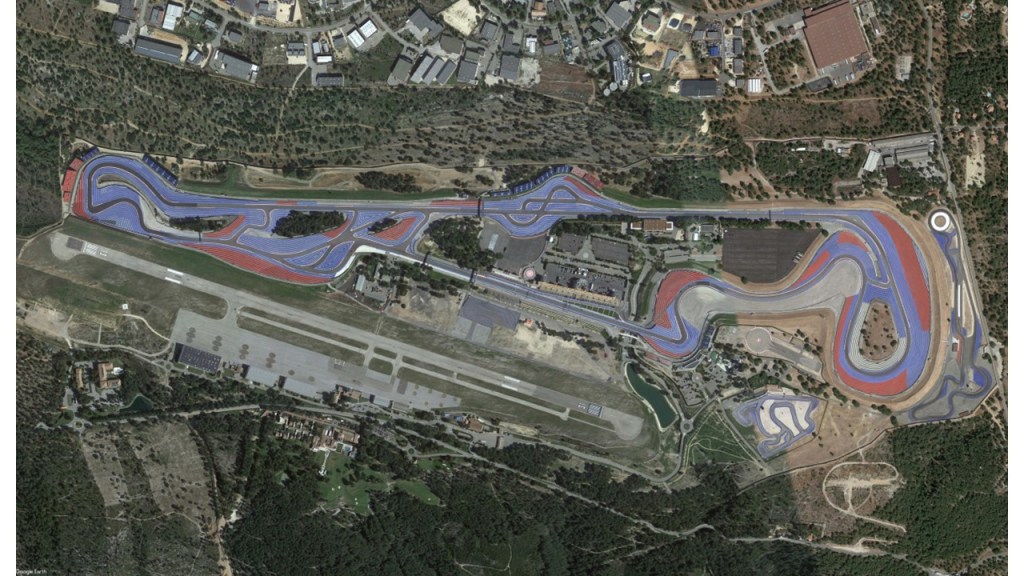
Layout: Actual
When was the track built?
Built between 1969 and 1970 by drinks magnate Paul Ricard, one of the first persons to use sports to promote his brands, it quickly became the most modern French circuit and started hosting F1 from the following year, for fourteen consecutive seasons.
It unfortunately suffered the fatal Elio de Angelis crash and from 1986 both F1 and MotoGP moved to different venues, until the track was bought by Bernie Ecclestone to be completely refurbished with pioneering safety and technical solutions; new pit facilities and new layout variants were added as well in the early 2000s.
It is hosting F1 Grand Prix again since 2018.
When was its first Grand Prix?
In 1971, won by Jackie Stewart, in a Tyrrell-Ford supremacy thanks to the second place of his teammate Cevert.
It is one of the eight French circuits that will rotate for spots in the European and World Title series.
What’s the circuit like?
The configuration that will be used from 2023 is the “old fashion” one, with the full length Mistral straight leading to the iconic Signes curve, where now cars touch the 300 km/h with 5g lateral.
The rest of the circuit is a mix of low-speed corners, particularly in sector 1, and high-speed ones, in the final part.
A challenging circuit for drivers and engineers to find the right set-up.
Where is it located? Few kilometers north of Le Castellet, in the south of France, with its own airport, for private flights only, and with other three major ones around. (+ 43°15’10”, + 5°47’33”)
 All Along The Racetrack