
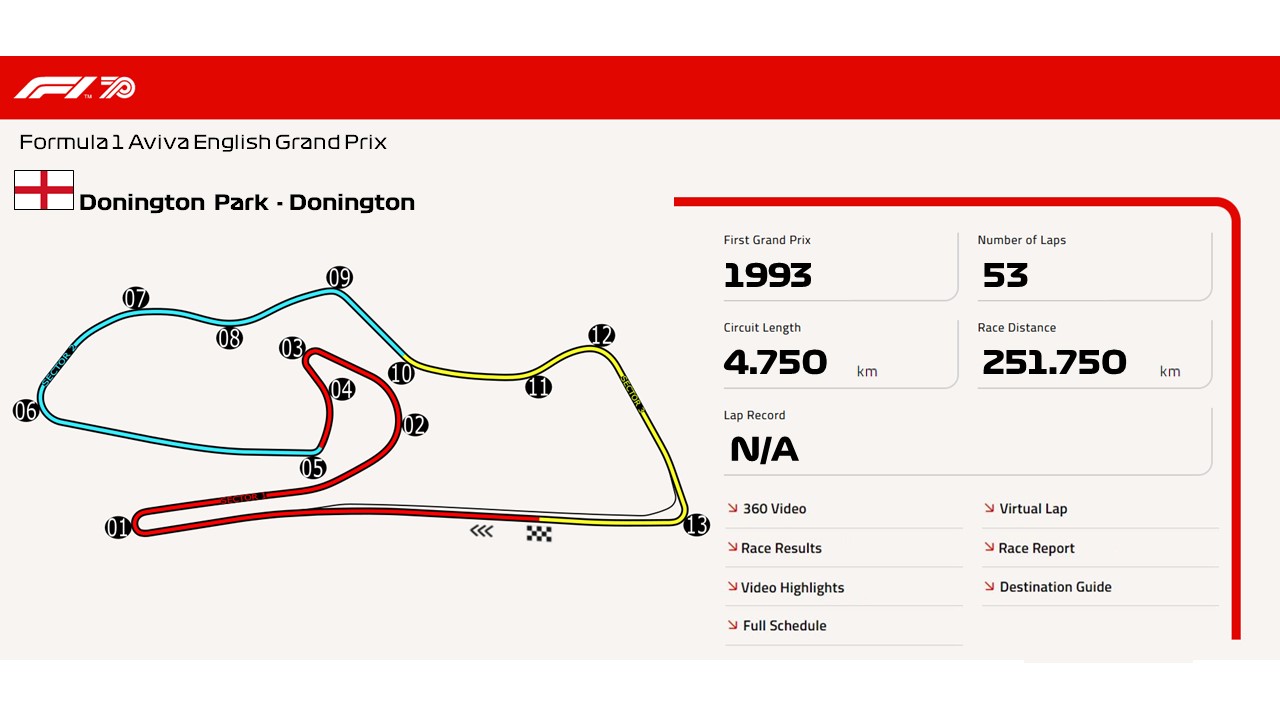
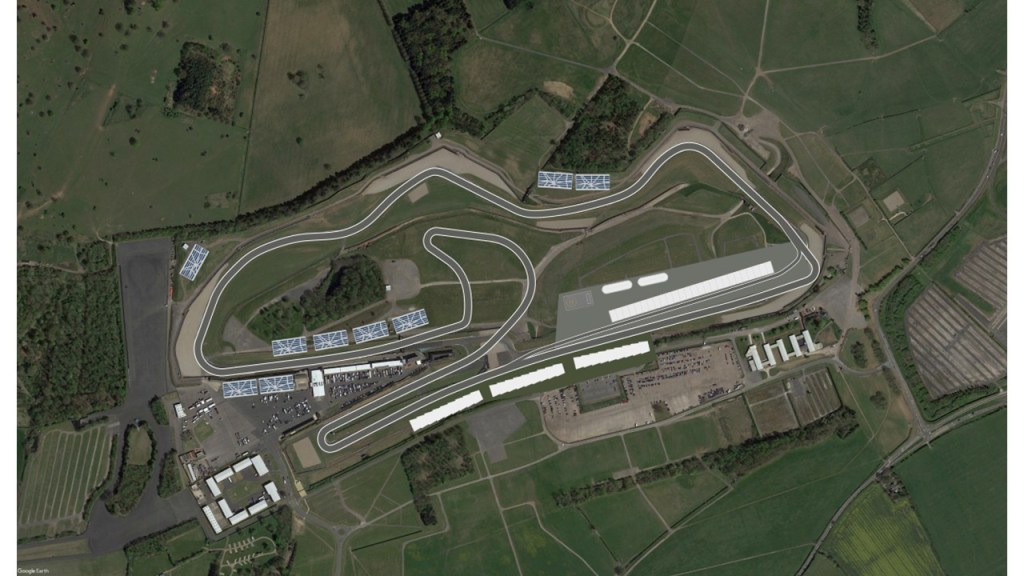
Layout: Actual
When was the track built?
One of British circuits with the most important heritage, it was built in the early 1930s and hosted several pre-war issues, but it was converted into a military vehicle depot in 1939 and was revived only in 1977.
It started hosting major events from 1985 when the Melbourne loop was added, including the legendary 1993 European Grand Prix; but it was only in 2010 that a more serious bid to take a spot in the Formula One calendar was made, thanks to Ecclestone’s effort and Tilke’s proposed modification.
Due to financial issues, and the competition of Silverstone, the project never started.
It will now be revamped to allow the circuit to be added to the new F1 Organization circuit database from 2023.
When was its first Grand Prix?
In 1993, the only F1 titled race held here, famous for the “lap of Gods” by Ayrton Senna, who took the lead after starting fourth on his McLaren-Ford, to win by over a minute in front of the superior Williams-Renault of Hill and Prost.
It’s one of the seven circuits to rotate for two spots in the European Continental Series and one in the World Title F1.
What’s the circuit like?
The main straight is moved to the former Starkey’s straight, which is now longer thanks to the removal of the Esses; it will now be a much better overtaking spot into the new T1, the Melbourne hairpin.
The new section completes the first sector, with a downhill long and challenging parabolic corner, leading to T3; after that a steep uphill bend brings back to the former main straight.
From T5 there is no change to the old layout up to the last corner, which is now sharper and aligned with the new straight.
By keeping the best parts of the old circuit and adding a new interesting element, it definitely suits Formula 1 and remains fun to drive.
Where is it located?
Near to Castle Donington in central England. The nearest airport in East Midlands Airport, which is adjacent to the eastern end of the circuit. (+ 52°49’47”, – 1°22’49”)
 All Along The Racetrack