
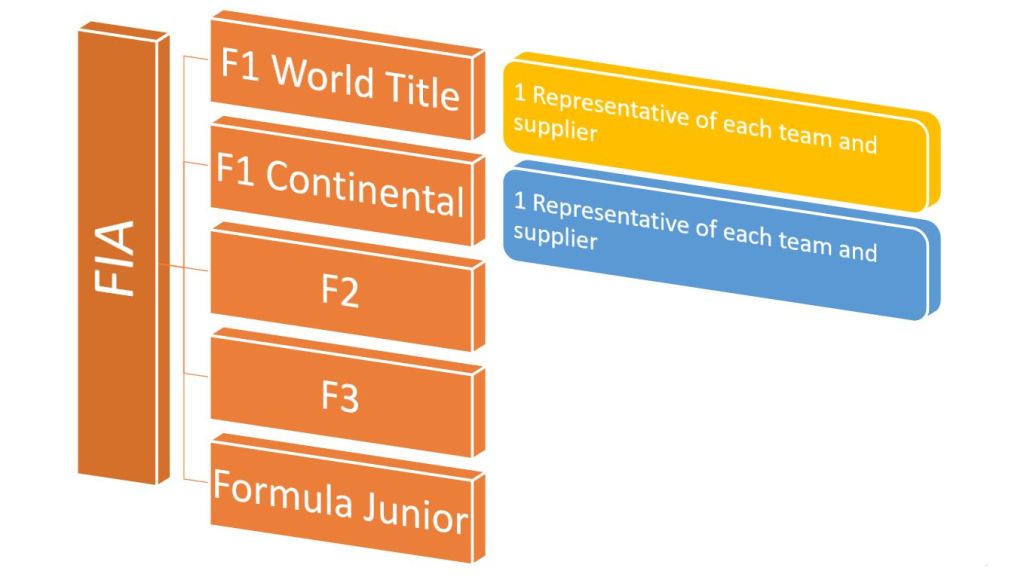
Let’s start from the top, because I’m strongly convinced that a good show on the racetrack is not linked only to how cars are designed and built, but also to political and financial decisions.
Firstly, the Formula One organization will no longer have an owner; this means it will be a parliament of each constructor and supplier participating aiming at achieving the best and most balanced technical rules.
Also financially, no rich families or funds to pay back every year.
Revenues can be split proportionally between participants based on their performances.
Furthermore, by eliminating big bonuses to wealthy owners, there will be a good amount of money to invest in development schools for drivers, improving circuits (instead of bleeding them to death with fees) or creating new ones.
Finally, the FIA will have to be more separated and free from any politics and will have to rule only about safety, auditing each car at every race and being a more impartial judge on safety related matters.
Any other sport-related settlement will be made by the FOO (Formula One Organization).
Possibly the biggest change is restructuring also preparatory series: after karting and Formula Junior, a 1.5 Liters engine with standard chassis series, there will be two other different categories with increasing engine power to 2 and 3 Liters and then Formula 1.
But the top series will be split into two different levels: the top one, World Title Formula 1, will declare the World Champion after a worldwide season.
F1 Continental, instead, will be restricted to drivers and constructors from each geographical area, and races held within the continent.
Same technical and safety rules, it will be the ultimate test for drivers before reaching the fight for the World Title, and it will support and enable the biggest possible diversity in terms of drivers and circuits.
It will be more clear in my next posts where I’ll explain financial rules and calendar for each season, but with very few organizational changes there will be the chance to increase revenues, with more races and less cost to organize them, split them better between participants, creating a more fair and balanced competition, and opening the doors to new countries and new drivers that would not have the financial resources to participate with the current management.
Calendar slots will no longer be given to a circuit, but assigned to a country, based on criteria that I’ll explain in a dedicated post, and circuits in each country will rotate year by year.
Here a list of the main organizational and technical rules of my proposal:
1) FIA will rule only about safety matters
2) The F1 organization is a parliament of representative from each team and supplier. No owners
3) The F1 organization will rule about calendar, money sharing, racing rules. No interference in safety decisions made by FIA
4) Any rule change is approved if it gets 51% of votes in favor
5) A constructor needs to manufacture at least chassis and aerodynamics parts
6) Brakes, gearbox and engine can be purchased
7) If an engine manufacturer is participating as a constructor, he can’t sell engines or other parts to any other constructor
8) Minimum weight is established
9) Chassis and brakes are subject to size and safety restrictions only
10) Engine and gearbox have only limitation in minimum and maximum weight. No restrictions in technology that can be used
11) Car maximum length and width to be established by rule
12) Engine will be subject to maximum CO2 emission/km
13) No limitations in the number of supplier for tires, brakes, gearbox and engine
14) Suppliers of tyres, engine, gearbox and brakes has to be chosen by each team at the beginning of the season
15) Private test are allowed and free
16) 2 types of tires: Qualy, for maximum performance, and Race, that need to last for the whole race
17) No restrictions in the number of entries; if a circuit can’t have all entries racing, slowest cars in Free Practice are excluded from qualification
18) Each team can have 1 or 2 cars participating
19) Calendar is done awarding a country a spot. Circuits inserted in the database will rotate year by year for each country
20) Circuits that match F1 criteria will be inserted in the database. Maximum 8 circuits per country (exception made for the U.S.A. which are split in 3 areas, for a total of 24 tracks)
21) Circuits are subject to safety limitations only (escape routes, medical facilities, etc.); no minimum/maximum length, no layout limitation
22) Racing weekend is made of 2 days: 1 hour and half Free Practice on Saturday Morning, Qualifying session in the afternoon, 30 minutes warm-up on Sunday Morning and race in the afternoon.
23) Race length is set at 250km
24) Set-up changes between qualifying and races are permitted.
25) No DRS or other overtake aid
26) Fuel tank has to be designed to complete full distance.
27) No tire changes allowed. Pit stops can be done in case of issues to the car.
As far as F1 Continental is concerned, there are some slight adjustments:
1) Constructors and drivers must be from the same continent of the competition
2) Constructor can also buy chassis and aerodynamics parts
3) All other technical rules are the same as F1 World Title
4) Chassis and Engine manufacturers not allowed to participate directly
5) There could be suppliers participating to the F1 continental that are not participating to F1 World Title
6) A constructor cannot buy a “full package” from a F1 World team

